Celestial navigation is probably the oldest method of determining position without landmarks. Over the centuries, remarkable methods and precision instruments have been developed for this purpose. The last mechanical instrument still used today is the sextant or drum sextant. In astronavigation, the sextant determines the vertical angle between a celestial body and the horizon. For coastal navigation it can also be used horizontally, e.g. to measure the distance from several landmarks. The micrometre drum represents the latest refinement of modern drum-type sextants. With this kind of drum adapter, the angles in degrees, minutes and tenths of a minute can effortlessly be read off. Older vernier sextants, on the other hand, are equipped with a graduated arc called a vernier. At Toplicht you will find simple sextants for practising and learning made of plastic, lightweight yacht sextants made of aluminium, noble semi-horizon and full-horizon sextants designed for professional use, illumination for sextants and artificial horizons.
You can find more detailed information on celestial navigation in our information hub.
Handy yacht extant with half-view mirror. Made of seawater-resistant cast aluminium, anodized and stove-enamelled, with plastic handle. Available in two colors: black or ivory.ZEISS lens with 3.2x magnification and 30mm aperture, distortion-free image thanks to high-quality, adjustable mirrors with tested flatness, five pivoting shadow glasses.The yacht sextant is used for finding and calculating the position by measuring the elevation angle between the sighting lines ship-chimney and ship-star or by measuring the horizontal angle near the coast.Technical featuresspecially manufactured for yachts and smaller shipsFilter frame made of cast aluminumhardly susceptible to interference, unaffected by electromagnetismPlastic handleDegree bend with graduation radius 142 mm, graduation length -2° to +123°, scale value 1°Drum with scale value 1'ZEISS objective 3.2 x 30 mmHigh-quality, adjustable mirrors (half-view)5 swing-in shadow glasses (3 index filters, 2 horizon filters)Supplied in a wooden case for safe storageTest certificate with individual correction valuesComprehensive operating and adjustment instructionsAdjustment keyDimensionsSextant 240 x 210 x 110 mm, weight 0.86 kg.Wooden case 265 x 240 x 150 mm, weight 2.8 kg.An lighting unit is optionally available (see "Accessories & spare parts").
Full-view drum sextant with certified correction values under 40".A precision instrument developed for professional maritime navigation, made of seawater-resistant aluminum. The sturdy strut body is cast without internal stress, fully anodized, and baked-on painted.The drum sextant enables position determination and calculation by measuring the elevation angle between the sight lines from the ship’s gunwale to a celestial body, or by measuring the horizontal angle near the coast.This traditional navigation method is virtually immune to interference, unaffected by electromagnetism, and independent of onboard electrical power.FeaturesOptimal adjustment accuracydistortion-free imaging thanks to high-quality mirrors with verified flatness, corrosion-resistant sealing, and fine-tuning capabilityBrightness compensation of the two partial images via swiveling filter glasses (3+4) with matched transmittanceEasy bearing determination thanks to a wide telescope field of view and a protective eyecupLightweight, heavily ribbed, and corrosion-resistant light-metal segmentOptimal protection of the sensitive alhidade between the segment and the handleTechnical SpecificationsProfessional full-view sextant with full horizon mirrorProtractor with a division radius of 170 mm, division range from -5° to 125°, scale value 1°Encapsulated, high-precision measuring drum with scale value 1´, estimation 0.1´JENA optics 4x40 (40 mm, 4x magnification)7 swiveling shadow glasses made of plane-parallel neutral glassPlastic handleColor: grayDimensions: 26 x 24 x 13 cm. Weight: 1.4 kgWooden case dimensions: 34 x 322 x 17 cm. Weight (with sextant): 4.5 kgWhat’s IncludedDrum sextant in wooden caseCertificate of CalibrationOperating and Adjustment InstructionsKey for mirror adjustmentThe Freiberger drum sextant is also available as a semi-visible sextant with certified correction values of less than 40" or less than 20" (see "Similar Products").
Simple sextant for practicing and learning. Grey plastic. Arc 178 mm, working range -10° to 100°. Prismatic reading with wide expanded nonius range (30 part dashes) allows measurements of up to 2' precision, the index mirror is moveable in two directions. Two pivoting shadow glasses as well as two shadow discs are in front of the viewer "telescope" (no lenses, no enlargement).
Sextant made from fibreglass-reinforced plastic with adequate precision for learning and practise. Good precision from a micrometer barrel, mirror with 7 shaded glasses. Object lens with triangular magnification. Comes in a plastic box: 255 x 230 x 120mm with German language manual.Colour: black.
The artificial training horizon allows for the measurement of celestial body altitude using a sextant when there is no view of the horizon—for example, at night, in ground fog, during voyages close to land, or for land navigation.The CELESTAIRE artificial practice horizon can be attached in place of the normal telescope. This works with sextants manufactured by Cassens & Plath. The practice horizon is not suitable for Davis plastic sextants.On the right side, the user looks over the sextant mirrors toward the celestial body and a horizontal line. To make an observation, the user holds the sextant vertically as usual. A bubble in the spirit level must align with the horizontal line. The celestial body is also centered on the horizontal line. When observing the Sun, its lower edge is used.The artificial training horizon is intended solely for training purposes and isNOT suitablefor navigation.You can find an artificial navigation horizon with BSH certification for commercial shipping (Item No. 3716-103) further down the page under “Related Items.”
Template for celestial navigation created by RYA Yachtmaster Ocean Instructor Leon Schulz in cooperation with the German sextant manufacturer Cassens & Plath.The clearly laid out DIN A4 sheet has proven itself in theory and practice and has helped hundreds of sailors to quickly understand, with helpful designations, information and notes, where in the sight reduction tables and Almanacs which values must be taken step by step.These are not only helpful for understanding celestial navigation, for example during an RYA Yachtmaster Ocean course, but above all as a later memory aid. The templates are clearly structured and provide step-by-step instructions on how to determine your own position.There is a template for observing the sun and one for determining the noon latitude.Each pad has 25 sheets (printed on one side). Texts in English.The free instructional videos on how to use the templates on Leon Schulz's homepage help you to familiarise yourself with the working method.www.reginasailing.com/celestial_videos/
The artificial horizon is a device for taking sun or moon shots without observing the natural horizon.Excellent help for practicing sextant observations at home.The plastic body is to be filled with water or equivalent liquid and must be positioned unmoved.May not be used on sea.Plastic body with glass windows and plastic shades.May not be used for noon shots (only for angles up to 45 degrees). Comes collapsable in a plastic box.
Lutz Böhme has been working for over 15 years for various sailing and sports boat schools in the training of sailing licences for the German certificates of competency Sportseeschifferschein (SSS) and Sporthochseeschifferschein (SHS).His special "hobbyhorse" is astronomical navigation. He has therefore compiled his various explanations, instructions and exercises on 75 pages for easy-to-understand, well-founded exam preparation.The very helpful, detailed script in ring binder form introduces astronavigation in easy-to-follow steps. It also deals with the great circle, cutlery and coupling calculations with information on using a pocket calculator for the current SHS navigation examinations.Currently the best source of information for SHS exam preparation in the field of astronavigation.The reading sample - see further down on this page under "Downloads & Information" - gives a good first impression (even if it is not from the latest edition).75 pages, numerous photos and illustrations, DIN A4 format, edition: June 2023. German edition.
Lutz Böhme has been working for over 15 years for various sailing and sports boat schools in the training of sailing licences for the German certificates of competency Sportseeschifferschein (SSS) and Sporthochseeschifferschein (SHS).He has therefore compiled his various explanations, instructions and exercises on 135 pages for easy-to-understand, well-founded exam preparation.In the terrestrial navigation section, he goes into particular depth on the content above the Sportküstenschifferschein (SKS), for example by describing current triangles lasting several hours.The topics of tidal science and calculations with the Admiralty Tide Tables (ATT) and electronic navigation are also covered. The chapter on shipping law also includes radar plotting and the evasive manoeuvres required for the SHS.A very helpful script in ring binder form.The reading sample - see further down on this page under "Downloads & Information" - gives a good first impression (even if it is not from the latest edition).135 pages, numerous photos and illustrations, DIN A4 format, edition: February 2024. German edition.
Lighting unit for the handy FREIBERGER yacht extant with half-view mirror.Until further notice, the lighting unit is only available in black.An AA battery is required for operation, which is not included in the scope of delivery.
SIRIUS semi-transparent drum sextant with certified correction values under 20".A precision instrument developed for commercial shipping, made of seawater-resistant aluminum. The sturdy strut body is cast without internal stress, fully anodized, and baked-on painted.The drum sextant enables position determination and calculation by measuring the elevation angle between the sight lines from the ship’s gunwale to a celestial body, or by measuring the horizontal angle near the coast.This traditional navigation method is virtually immune to interference, unaffected by electromagnetism, and independent of onboard electrical power.FeaturesOptimal adjustment accuracydistortion-free imaging thanks to high-quality mirrors with verified flatness, corrosion-resistant sealing, and fine-tuning capabilityBrightness compensation of the two partial images via swiveling filter glasses (3+4) with matched transmittanceEasy bearing determination thanks to a wide telescope field of view and a protective eyecupLightweight, heavily ribbed, and corrosion-resistant light-alloy segmentOptimal protection of the sensitive alhidade between the segment and the handleTechnical SpecificationsProfessional split-view sextant with half-horizon mirrorProtractor with a scale radius of 170 mm, scale range from -5° to 125°, scale division of 1°Encapsulated, high-precision measuring drum with scale value 1', accuracy 0.1'JENA optics 4x40 (40 mm, 4x magnification)7 swiveling shadow glasses made of plane-parallel neutral glassPlastic handleColor: grayDimensions: 26 x 24 x 13 cm. Weight: 1.4 kgWooden case dimensions: 34 x 322 x 17 cm. Weight (with sextant): 4.5 kgWhat’s IncludedDrum sextant in wooden caseCertificate of CalibrationOperating and Adjustment InstructionsKey for mirror adjustmentThe Freiberger drum sextant is also available with certified correction values below 40" as a full-view sextant and as a half-view sextant (see "Similar Products").
Semi-transparent drum sextant with certified correction values under 40".A precision instrument developed for commercial shipping, made of seawater-resistant aluminum. The sturdy strut body is cast without internal stress, fully anodized, and baked-on painted.The drum sextant enables position determination and calculation by measuring the elevation angle between the sight lines from the ship’s gunwale to a celestial body, or by measuring the horizontal angle near the coast.This traditional navigation method is virtually immune to interference, unaffected by electromagnetism, and independent of onboard electrical power.FeaturesOptimal adjustment accuracydistortion-free imaging thanks to high-quality mirrors with verified flatness, corrosion-resistant sealing, and fine-tuning capabilityBrightness compensation of the two partial images via swiveling filter glasses (3+4) with matched transmittanceEasy bearing determination thanks to a wide telescope field of view and a protective eyecupLightweight, heavily ribbed, and corrosion-resistant light-alloy segmentOptimal protection for the sensitive alhidade between the segment and the handleTechnical SpecificationsProfessional split-view sextant with half-horizon mirrorProtractor with a scale radius of 170 mm, scale range from -5° to 125°, scale division of 1°Encapsulated, high-precision measuring drum with scale value 1', accuracy 0.1'JENA optics 4x40 (40 mm, 4x magnification)7 swiveling shadow glasses made of plane-parallel neutral glassPlastic handleColor: grayDimensions: 26 x 24 x 13 cm. Weight: 1.4 kgWooden case dimensions: 34 x 322 x 17 cm. Weight (with sextant): 4.5 kgWhat’s IncludedDrum sextant in wooden caseCertificate of CalibrationOperating and Adjustment InstructionsKey for mirror adjustmentThe Freiberger drum sextant is also available as a full-view sextant with certified correction values below 40" and as a half-view sextant with certified correction values below 20" (see "Similar Products").
The BOBBY SCHENK model incorporates the design ideas of this experienced offshore sailor.On this sextant, which features a full-view mirror for easy handling, the index correction can be adjusted directly via the drum screw. Telescope: 4 x 40 mm; 7 shadow glasses; indirect, glare-free illumination.The white body ensures that the sextant does not heat up as much, even in direct sunlight.What’s IncludedYellow rough case—shock-resistant caseThe sextant can be engraved upon requestOptional accessory: Small chronograph (quartz watch) for determining the reading time (see “Accessories & Replacement Parts”).
The Horizon Ultra is Cassens & Plath’s top-of-the-line sextant. This precision angle-measuring instrument for astronomical positioning has a certified instrument error of < +/- 5".Manufactured in Germany, this sextant with a 4x40 mm telescope is available with either a full-view mirror or a clear-view mirror. You can find an explanation of the differences in our resource center. The sextant is easy to handle and offers perfect readability. The indirect, glare-free illumination contributes to this. This high-quality navigation instrument features special polarized shade glasses that are exclusively installed in the Horizon Ultra. One glass each for the horizontal and vertical directions simplifies the handling of the sextant during observation.By rotating the lens, the brightness of the celestial body can be adjusted continuously. This has the advantage that no polarizing lenses need to be removed or added during observation, making it easier to keep the celestial body in the field of view.In addition, the sextant is equipped with a double prism (Schüler type). It directs the horizontal line of sight to the right and left of the sun’s reflection on the water, thereby preventing measurement errors caused by lighting conditions. Furthermore, any vertical tilt of the sextant can be immediately detected in the horizon line.Polarizing filters and the Schüler double prism make the Horizon Ultra the go-to instrument for solar observations.The drum screw features scales for combined horizon depth and index adjustment.As with all Cassens & Plath sextants, the radius of the arc complies with international standards and meets accuracy tolerances.The sextant frame is milled from a 5.5-kilogram brass plate and ultimately weighs 600 grams. After milling, the frame is heated in a furnace, straightened, ground, and engraved. Any distortions that may result from milling and heating are corrected with light, precise hammer blows. Finally, the stress-free strut assembly is stove-enameled, and then the individual components are mounted on the frame.The Horizon Ultra is available in two colors:With a white body to prevent excessive heating from sunlightWith a classic black bodyThe telescope has 4x magnification and a 40 mm objective aperture. The seven swiveling eyepieces are made of plane-parallel neutral glass. The adjustable, high-quality mirrors are certified for flatness.It is shipped either in a wooden case or a plastic “Rough Case”—both included in the price. Information on the two case types can be found under “Accessories & Spare Parts.”When placing your order, please specify your choice of “Full View / Open View” and “Wooden Case / Rough Case” in the comments section. If you would like an engraving (also included in the price), please also specify the desired text here (e.g., the name of the owner or the ship).The items in stock are unengraved clear-view sextants in wooden cases. Technical SpecificationsMeasuring range: -5° to +125°Instrument error: < ±5"Reading accuracy: >10" or 0.17'Number of AA or R6 batteries (1.5 V): 2Horizon mirror: choice of full-view or clear-viewHorizon mirror diameter: 56 mmIndex mirror dimensions: 56x42 mmFrame material: brassMirror cap material: seawater-resistant magnesium-aluminum alloyWeight: 1.8 kgPrinciple of the 4x40 telescope: Galilean, erect imageMagnification: 4xObjective diameter: 40 mmAngle of view: 8°Field of view: 131 m / 1,000 mExit pupil: 5 mmGeometric luminous intensity: 100Twilight factor: 12.7Focusing: rotatable eyepiece mountScope of deliverySextant (full-view or open-view—please specify in the comments section of your order)Selected case (wooden case or rough case—please specify in the “Comments” section of your order)Mirror adjustment keyCloth for cleaning optical componentsBrushUser manualCertificate of Quality
The PROFESSIONAL sextant from Cassens & Plath is a precision angularfor astronomical navigation. It has been type-approved by the Federal Maritime and Hydrographic Agency (BSH) (see “Downloads”) and has an instrument error of < +/- 5”.It MUST be delivered in a case. Please select the desired case option under “Accessories & Replacement Parts.”The sextant, manufactured in Germany with a 4x40 mm telescope, is available with either a traditional half-view mirror, a full-view mirror, or a clear-view mirror. You can find an explanation of the differences in our Information Hub. Furthermore, the half-view and full-view sextants do not require illumination.As with all Cassens & Plath sextants, the radius of the arc complies with international standards and meets accuracy tolerances.The sextant frame is milled from a 5.5-kilogram brass plate and ultimately weighs 600 grams. After milling, the frame is heated in a furnace, straightened, ground, and engraved. Any distortions that may result from milling and heating are corrected with light, precise hammer blows. Finally, the stress-free strut assembly is given a black baked-on finish, and then the individual components are mounted on the frame.The telescope has 4x magnification and a 40-mm objective aperture. The seven swiveling eyepieces are made of plane-parallel neutral glass. The adjustable, high-quality mirrors have been tested for flatness.Technical SpecificationsMeasuring range: -5° to +125°Instrument error: < ±5″Reading accuracy: >10" or 0.17'Number of AA or R6 (1.5 V) batteries (for optional illumination): 2Horizon mirror: choice of half-view, full-view, or clear-viewHorizon mirror diameter: 56 mmIndex mirror dimensions: 56x42 mmFrame material: brassWeight: 1.8 kgPrinciple of the 4x40 telescope: Galilean, upright imageMagnification: 4xObjective lens diameter: 40 mmAngle of view: 8°Field of view: 131 m / 1,000 mExit pupil: 5 mmGeometric light intensity: 100Twilight factor: 12.7Focusing: rotatable eyepiece mountPackage ContentsSextantSelected carrying case (see “Accessories & Replacement Parts”—must be ordered separately)Mirror adjustment keyCloth for cleaning optical componentsBrushUser manualCertificate of Quality
An optional accessory to the CASSENS & PLATH sextants:a small chronograph (quarz watch with stop function) to register the reading time.With bracket which fits on the sextant.
The artificial navigation horizon is required for measuring the celestial altitude with the sextant when there is no horizon visibility, for example at night, in ground fog, when traveling under land or for land navigation.The artificial horizon can be used on all CASSENS & PLATH sextants that are equipped with illumination, as it requires a power supply. These are the sextant models Horizon Ultra, Polaris, Bobby Schenk and Professional (with illumination).The artificial horizon can easily be exchanged for the normal sextant telescope thanks to its clamping screw. No adjustment is necessary.The device is used as a normal sextant telescope (3 x 25 mm) with a bubble level inserted into the optical path. A crosshair and the dragonfly bubble appear in front of a red illuminated background. A dimmer allows the brightness to be optimally adjusted to the external lighting conditions. An additional shade glass can be attached to the lens for solar observations.The artificial horizon is suitable for navigation and approved for commercial shipping under BSH/047/01/78.For purely training purposes, the artificial training horizon (article no. 3716-113) is an inexpensive alternative. You can find it under "Similar products".A suitable case is available as an accessory to provide optimum protection when storing the artificial navigation horizon.
The German edition of the book is being discontinued by the publisher.David Barrie (born 1953) is a butterfly researcher, chairman of various foundations, passionate sailor and great author with great enthusiasm for navigation topics.With his first book "SEXTANT - A voyage guided by the stars and the men who mapped the world's oceans" he succeeded in creating a successful mixture of adventure, science, mathematics and heroic deeds. Above all, however, the book is also a declaration of love for the sea. "Barrie ties everything together in a light, airy way, surprises with historical detail, pays tribute to the courage of the first seafarers setting out into the unknown and brings tragic fates out of the mist of the past," a review said.Barrie describes how unknown the outlines of entire continents were just 250 years ago. Orientation by the stars was considered imperfect. Only a new observation instrument gave the modern world its shape: the sextant. David Barrie tells the story of how and why it was invented, how vital it was for seafarers and what a central role it played in the history of exploration and discovery.He artfully combines the experiences of intrepid seafarers such as James Cook, La Pérouse and Joshua Slocum with memories of his own Atlantic crossing, which he undertook as a young man.352 pages, 12.2 x 18 cm, paperback. German edition. English edition.
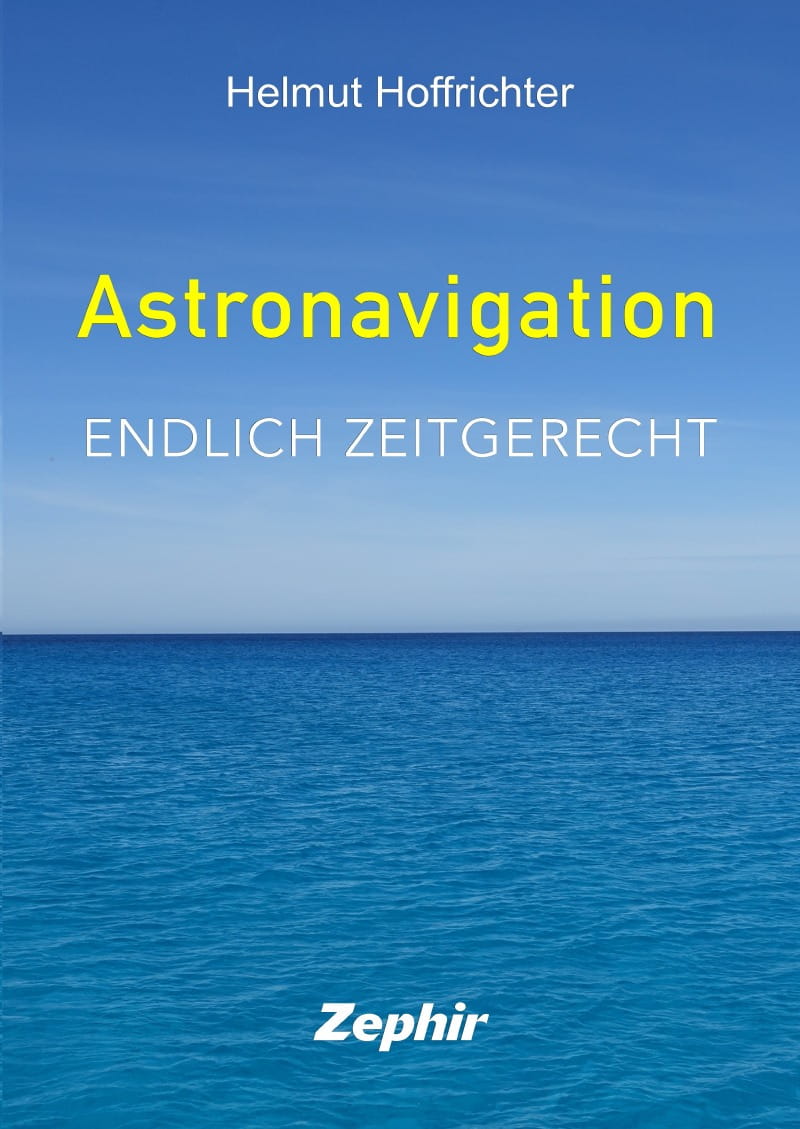
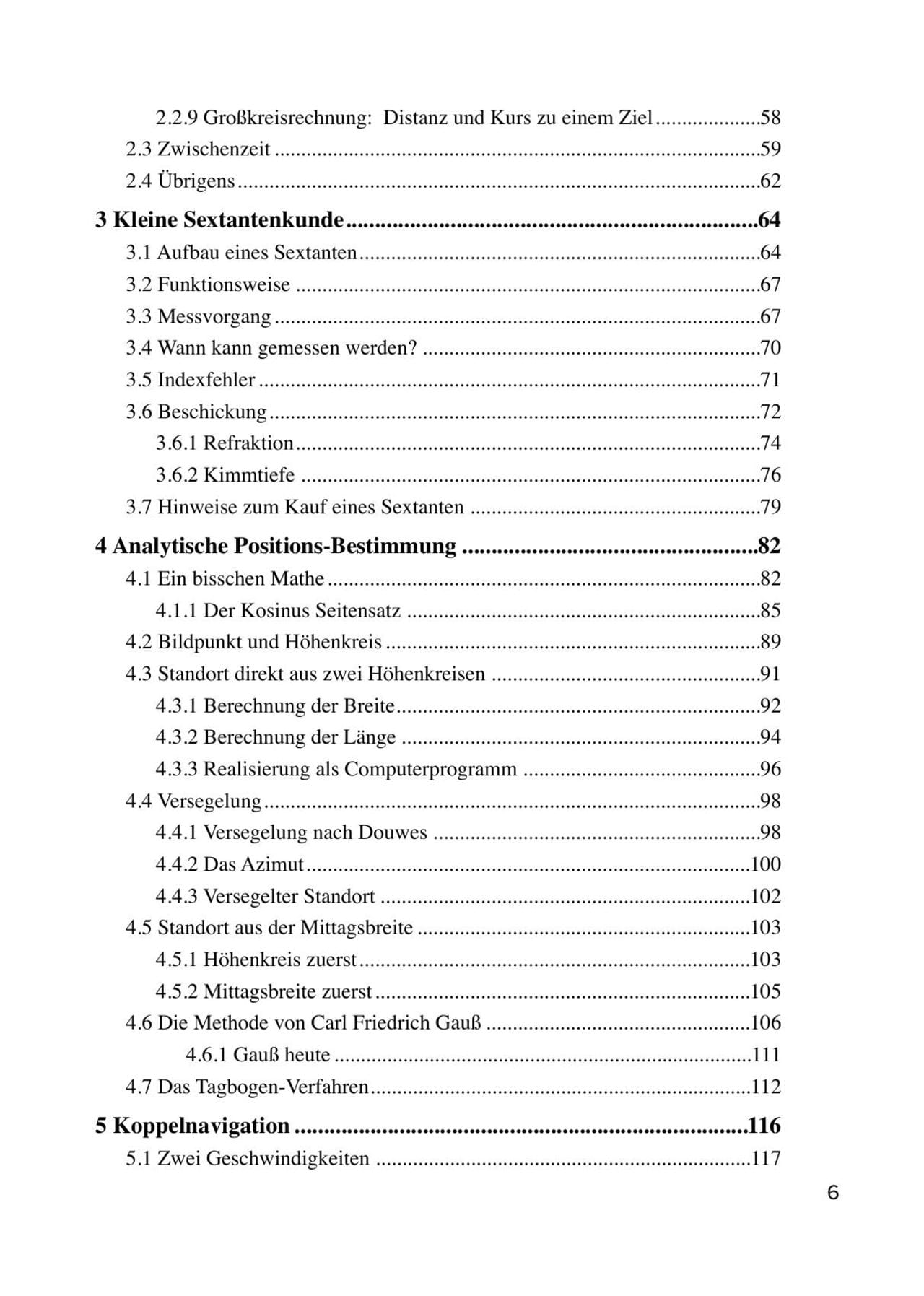
Astronavigation has the status of a secret science from the last millennium - interesting, demanding, completely outdated and far too strenuous. Most water sports enthusiasts only study it - if at all - in preparation for an exam, such as the German Sporthochseeschifferschein (SHS) or the British RYA Yachtmaster Ocean.In the event of a total power failure on board or interference with satellite signals, astronavigation is still regarded as THE backup for GPS & Co. But who can really switch to the navigation system of our ancestors on an ad hoc basis or even has the necessary nautical documents on board?Helmut Hoffrichter has developed a completely computerised method of determining location using the sun and a sextant, which he calls ‘postmodern astronavigation’. The revised, expanded 2025 edition of his book "Postmodern Astronavigation. Travelling with the sun" has been published.The book begins with an easy-to-understand review of the history of astronomical navigation. Hoffrichter then introduces his self-developed app ‘Circle of position navigation’ (Apple) and ‘Sun Navigation’ (Android).A sextant is used to measure the distance to the unmistakable sun. For the sake of simplicity, planets and fixed stars are left out as natural celestial bodies. After measuring the elevation angle, astronavigation traditionally begins with an extensive mathematical calculation and then a graphical approximation method. This was devised in 1875 by the French naval officer Marcq Saint-Hilaire (1832-1889) as an ‘emergency solution’ that was solely due to its time.Although mathematically exact navigation methods have been known since the mid-18th century, the calculation could not be automated without a computer. In Hoffmeister's app, the elevation angle measurements can simply be entered on a mobile device. Of course, the tablet or smartphone would have to run independently of the on-board power supply failure.The long-displaced methods of mathematicians Johannes Keppler (1571-1630) and Leonhard Euler (1707-1783) as well as the ephemeris are stored in the software, which performs the location calculation at lightning speed. After using the sextant, ‘postmodern astronavigation’ is as easy to use as the familiar satellite navigation on the chart plotter. Extensive nautical documentation is not required, nor do you have to do any calculations or drawings yourself.With ‘postmodern astronavigation’, a location can be determined more precisely with the help of the sun than with the Saint Hilaire altitude difference method. Since this does not even require a gissort, the art of earlier navigators is simplified to such an extent that a genuine, easy-to-use, practical navigation backup is now available.The chapters in detailHistory of astronavigationThe Sun Navigation appA little sextant loreAnalytical position determinationDead reckoningGreat circle calculationThe equation of timeAppendix, including an extract from the 1809 publication by Carl Friedrich Gauss (1777-1855) in which he solves the two-height problem188 pages, 70 illustrations and 15 tables, format 14.8 x 21 cm, hardback. German edition.
There is still one copy of the 2026 Nautical Yearbook available. If you would like this copy, please indicate so in the "Comments" section of your order.With this new edition of the Nautical Yearbook, Mainz-based physicist Prof. Dr. Harald Merkel provides the ephemerides and tables for astronavigation at sea—in the tried-and-true print format and classic layout.With this printed collection of data, you can ensure you remain independent of potential failures of electronic navigation systems.The Nautical Yearbook consists ofdaily pages of ephemerides for the Sun, Moon, planets, and fixed starsComprehensive data sets and conversion tablesStar charts and planetary orbits for orientation in the skyInformation on determining latitude from the altitude of the North StarSunrise and sunset times for the Sun and MoonFixed stars, seasons, equation of time, lunar phases, visibility of the planetsSemiversus tablesYou can find a sample excerpt under “Downloads.”443 pages, size 21.6 x 28 cm, paperback.
Measuring the elevation angle of celestial bodies with a sextant is impossible if no natural horizon is visible or if it is too imprecise to recognize.This is precisely when the artificial horizon from the Saxon sextant manufacturer FREIBERGER comes into play. It is mainly used on land, for example for training purposes with the sextant.It measures the angle between a star and its mirror image, which is visible in the dark, extremely flat glass plate. It must be halved for evaluation.The glass plate rests in a metal frame and is leveled by three foot adjusting screws using two spirit levels.Technical featuresDiameter: 125 mmAccuracy of the spirit level: 30" / 2 mmThe artificial horizon is supplied in a wooden boxTotal weight: 1.6 kg
The star finder globe shows the constellations and fixed stars as mirror images on a sphere. In this way, the starry sky is displayed true to life and without the distortion that is unavoidable in a two-dimensional display.The sphere can be rotated according to the local hour angle and the world axis can be tilted according to the geographical latitude.The star globe can be used forlocating stars and constellationsnaming a measured star or determining the pre-setting values of the sextant for a measurementdisplaying the apparent star movement.The celestial coordinates, local hour angle and declination (from the nautical yearbook) of a star can be set on the star finder globe. The azimuth, i.e. direction, and altitude to the horizon location can be read from the star location found in this way. This allows, for example, Venus, which is not visible to the naked eye in the daytime sky, to be found through the telescope of the sextant.Conversely, azimuth and altitude can be used to determine the name of the unknown star at the celestial coordinates found.The star finder globe is labeled in English, as is customary in the shipping industry. Alternatively, it is also available with German lettering. Please feel free to ask us about this.As the starry sky changes, it makes sense to replace the actual sphere of the star finder globe every few years. This is the only way to ensure that the current star constellation is displayed. You can find the replacement globe under "Accessories & spare parts".Technical featuresTotal height: 210 mmSphere diameter: 170 mmThe star globe is supplied in a wooden box.Total weight: 2.2 kg
A sextant is a precision instrument that should be serviced every three or five years at the latest.This service is also interesting if you are thinking about buying a used sextant. After the inspection, you can be sure that you are buying a precise measuring instrument. Perhaps the buyer and seller can share the costs.We offer the maintenance of sextants from the manufacturers CASSENS & PLATH and FREIBERGER.The price quoted is the basic price for simple maintenance including cleaning of the frame and optical components.If maintenance of the mechanical components (spindle etc.) or even replacement of individual components is also required, you will first receive a cost estimate for this.At the end, the sextant is readjusted and tested on the test bench. It will then receive a new quality certificate.Sextants from other manufacturers can also be serviced. The plastic sextants from DAVIS are an exception, as they do not fit on the test stands.If repairs are required on a sextant from another manufacturer, the necessary spare parts will generally not be available. C. PLATH brand sextants may be an exception, as they are at least partially identical in construction to CASSENS & PLATH instruments.The sensible first stepIt generally makes sense to send us one or two informative photos of the instrument and, if applicable, the certificate in advance.This enables us to tell you whether your instrument can be serviced in principle before we send you the sextant. It may also be possible to determine whether it will be necessary to replace components or carry out more extensive repairs. You will then receive an initial rough cost estimate.
Functional cookies are absolutely necessary for the functionality of the web shop. These cookies assign a unique random ID to your browser so that your unhindered shopping experience can be guaranteed over several page views.
Session:
The session cookie stores your shopping data over several page views and is therefore essential for your personal shopping experience.
CSRF token:
The CSRF token cookie contributes to your security. It strengthens the security of forms against unwanted hacker attacks.
Timezone:
The cookie is used to provide the system with the user's current time zone.
Cookie settings:
The cookie is used to store the cookie settings of the site user over several browser sessions.
Cache handling:
The cookie is used to differentiate the cache for different scenarios and page users.
Information on origin:
The cookie stores the referrer and the first page visited by the user for further use.
Activated cookies:
Saves which cookies have already been accepted by the user for the first time.
CAPTCHA integration
Age check / minimum age:
Check of age for specific catgories and products
PayPal payments
Wishlist
YouTube video
Google Maps:
We use Google Maps to display maps. For this purpose, we integrate an external service from Google, which may access and evaluate personal data. Privacy policy of Google
Youtube / Vimeo:
This cookie is required for playing youtube videos which use cookies.
Matomo Tracking:
Tracking statistics for the optimization of user workflows. No personal data is stored.
language-redirected
Cookie Konfiguration:
Das Cookie speichert, welche Cookies zum Zeitpunkt der Cookie Zustimmung angeboten wurden, damit bei einer Änderung der Cookie-Konfiguration eine erneute Zustimmung eingeholt werden kann.
Cookie-Configuration-Hash
Cloudflare Turnstile (spam protection):
Protects the forms against spam. Loads a script from challenges.cloudflare.com, which processes technical data such as your IP address and browser details.
Stores recently viewed products in the browser (localStorage)
shopwarePayments.cookie.paypal
shopwarePayments.cookie.googlePay
Enhanced Conversion Tracking
Enhanced Conversion Tracking
Enhanced Conversion Tracking
Enhanced Conversion Tracking
Enhanced Conversion Tracking
Enhanced Conversion Tracking
Enhanced Conversion Tracking
Enhanced Conversion Tracking
Enhanced Conversion Tracking
Enhanced Conversion Tracking
Enhanced Conversion Tracking
Enhanced Conversion Tracking
Enhanced Conversion Tracking
Enhanced Conversion Tracking
Enhanced Conversion Tracking
Enhanced Conversion Tracking
Enhanced Conversion Tracking
Enhanced Conversion Tracking
Enhanced Conversion Tracking
Enhanced Conversion Tracking
Enhanced Conversion Tracking
Enhanced Conversion Tracking
Enhanced Conversion Tracking
Enhanced Conversion Tracking
Enhanced Conversion Tracking
Enhanced Conversion Tracking
Enhanced Conversion Tracking
Enhanced Conversion Tracking
Vimeo video
Service cookies are used to provide the user with additional offers (e.g. live chats) on the website. Information obtained via these service cookies may also be processed for site analysis.
Persistent cart:
Saves the shopping cart of the shop customer across sessions.
Persistent cart:
Saves the shopping cart of the shop customer across sessions.
Persistent cart:
Saves the shopping cart of the shop customer across sessions.
Persistent cart:
Saves the shopping cart of the shop customer across sessions.
Persistent cart:
Saves the shopping cart of the shop customer across sessions.
Persistent cart:
Saves the shopping cart of the shop customer across sessions.
Persistent cart:
Saves the shopping cart of the shop customer across sessions.
Persistent cart:
Saves the shopping cart of the shop customer across sessions.
Persistent cart:
Saves the shopping cart of the shop customer across sessions.
Persistent cart:
Saves the shopping cart of the shop customer across sessions.
Persistent cart:
Saves the shopping cart of the shop customer across sessions.
Persistent cart:
Saves the shopping cart of the shop customer across sessions.
Persistent cart:
Saves the shopping cart of the shop customer across sessions.
Persistent cart:
Saves the shopping cart of the shop customer across sessions.
Persistent cart:
Saves the shopping cart of the shop customer across sessions.
Persistent cart:
Saves the shopping cart of the shop customer across sessions.
Persistent cart:
Saves the shopping cart of the shop customer across sessions.
Persistent cart:
Saves the shopping cart of the shop customer across sessions.
Persistent cart:
Saves the shopping cart of the shop customer across sessions.
Persistent cart:
Saves the shopping cart of the shop customer across sessions.
Persistent cart:
Saves the shopping cart of the shop customer across sessions.
Persistent cart:
Saves the shopping cart of the shop customer across sessions.
Persistent cart:
Saves the shopping cart of the shop customer across sessions.
Persistent cart:
Saves the shopping cart of the shop customer across sessions.
Persistent cart:
Saves the shopping cart of the shop customer across sessions.
Persistent cart:
Saves the shopping cart of the shop customer across sessions.
Persistent cart:
Saves the shopping cart of the shop customer across sessions.
Persistent cart:
Saves the shopping cart of the shop customer across sessions.
Persistent cart:
Saves the shopping cart of the shop customer across sessions.
Persistent cart:
Saves the shopping cart of the shop customer across sessions.
Persistent cart:
Saves the shopping cart of the shop customer across sessions.
Persistent cart:
Saves the shopping cart of the shop customer across sessions.
Persistent cart:
Saves the shopping cart of the shop customer across sessions.
Marketing cookies are used to display advertisements on the website in a targeted and individualized manner across multiple page views and browser sessions.
Google Analytics
Morayne:
Enables the optimization of various functions, such as the search in our shop.
Google Advertising
Stored data:
Shopware Analytics adds the following information to your browser's local storage until consent is revoked: _swa_anonymousId (a unique identifier of the visitor), _swa_userTraits (user traits of the visitor).
Google Tag Manager
Google Analytics
Google Ads
Here you can choose which cookies are enabled. You can choose between cookies that are necessary for the operation of the website and additional marketing cookies. If you select all cookies, we will collect data for the analysis and control of advertising campaigns.
Request sent successfully
Request wasn't send - a error occured. Please try again.