Here I am! Emergency transmitters help to find a damaged yacht or a person who has fallen overboard. For this purpose, the emergency alarm and the GPS position are transmitted via various channels: via COSPAS/SARSAT satellites, as a radar echo, via AIS or DSC. Bright LED and infrared light signals additionally help with the approach. To choose the right distress beacon from EPIRB, PLB, SART, AIS-SART and MOB, two questions need to be answered first: Do I want to draw attention to a vessel or person? Should my distress signal be able to be received at close range or (beyond) at long range? To be found again as a person who has fallen overboard, a MOB (Man Overboard Beacon) or PLB (Personal Locater Beacon) can be used. The MOB alerts via AIS and DSC in close range, the PLB uses the worldwide available COSPAS/SARSAT system. State-of-the-art PLBs combine these technologies in one device. In an emergency, the ship is alerted via a SART (Search and Rescue Radar Transponder) or an AIS-SART (Search and Rescue Radar Transmitter) at close range and at long range via an EPIRB (Emergency Position Indicating Beacon). Again, equipment is available that uses multiple alerting paths simultaneously. While vessels are required to carry certain emergency transmitters, more and more recreational crews are also increasing their safety by doing so.
Distress beacons

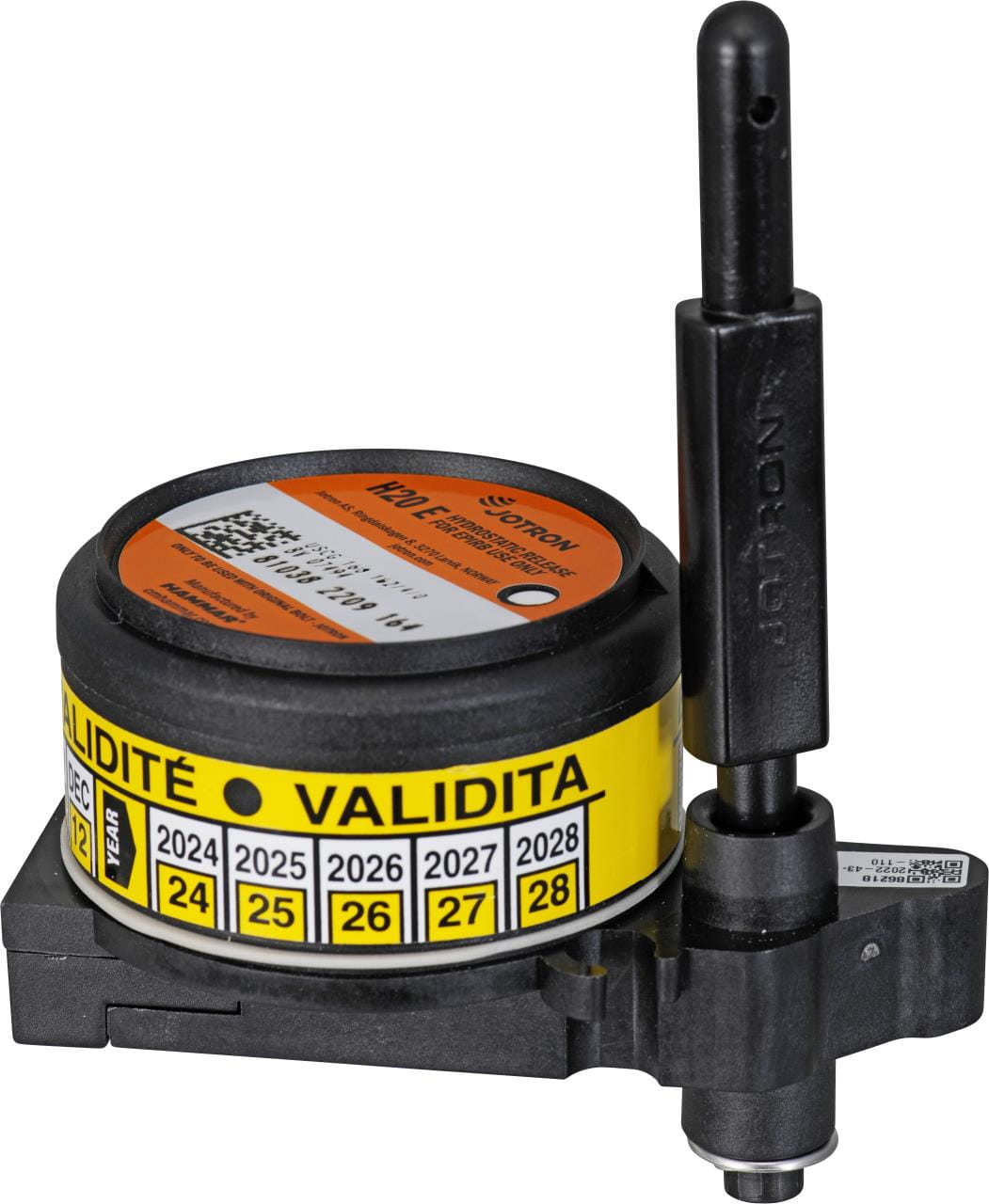
MED / SOLAS approval.Hydrostatic release unit (HRU) specially modified for replacement in EPIRBs made by JOTRON.The unit consists of the HAMMAR H20E hydrostatic release unit (HRU), the securing bolt (this must be replaced each time the release unit is replaced!), seals, screws and a securing clip with cord.In detail, the HRU (Hydrostatic Release Kit FB-60/FB-40/FBH-40/FB-42/FBH-42, 86218) fits the following EPIRBs:Tron 40AIS EPIRBTron 40VDR EPIRBTron 40AIS VDR EPIRBTron 60S EPIRBTron 60GPS EPIRBTron 60AIS EPIRBBefore installation, the HRU must be marked with the appropriate two-year approval mark (from installation).Should the vessel sink, a spring-loaded blade in the HRU will cut the securing bolt at a water depth of 1.5 - 4 metres, allowing the EPIRB to float freely.

Lithium replacement battery (ACR1104) for the ACR GlobalFix V4 EPIRB.Attention: The battery does not fit the newer GlobalFix V5 and GlobalFix V6 EPIRBs. For these, the battery must be replaced by a service company.In the GlobalFix V4 EPIRB, the battery can be changed independently. Transporting the battery in a car within Germany is permitted without any restrictions. If the battery is to be transported in an aircraft, please check with the airline in advance.

MED / SOLAS approval.McMURDO HRU Replacement Kit. The two variants replace the McMURDO Break t-HRU.The kit has been specially developed for replacement in EPIRBs from the manufacturer McMURDO. It consists of the Hammar hydrostatic water pressure release unit (HRU), the standard safety bolt (this must be replaced every time the release unit is replaced!), seals, screws and a safety clip with safety cord.The HRU for E3/G4/E5/G5 (82-962-0001A) fits the following EPIRBs (also from other manufacturers):McMURDO E5, G5, E3, G4, Rescue 406, Precision 406Kannad Marine EPIRB, SportPro, SportPro PlusSAILOR EPIRB I, EPIRB II, 406&GPS, SGE/SE 406-IIThe HRU for E8/G8 (23-145A) fits the following EPIRBs (also from other manufacturers):McMURDO Smartfind E8 AutoMcMURDO Smartfind G8McMURDO Smartfind G8 Auto AISKannad SafePro AIS AutoKannad SafePro AutoSailor 4065 EPIRB GNSS AutoSailor 4065 EPIRB AutoPrior to installation, the appropriate two year approval period mark (from installation) must be made on the HRU.Should the vessel sink, a spring-loaded blade in the HRU will cut the securing bolt at a water depth of 1.5 - 4 metres, allowing the EPIRB to float freely.

MED / SOLAS approval.Hydrostatic release unit HRU HydroFix (ACR 9490.1) for ACR GlobalFix EPIRB.Specifically, the HRU fits the following ACR EPIRBs:GlobalFix V4GlobalFix V5GlobalFix V6The unit consists of the hydrostatic release unit (HRU), the securing bolt (this must be changed each time the release unit is replaced!) and split pins.Before installation, the corresponding marking of the approval period of two years (from installation) must be made on the HRU.Should the vessel sink, a spring-loaded blade in the HRU will cut the securing bolt in a water depth of 1.5 - 4 metres, allowing the EPIRB to float up freely.

MED / SOLAS approval.The HAMMAR H20E hydrostatic release unit (HRU) releases the floatfree EPIRB when the ship sinks.A spring activated knife cuts the release rod at a water depth of 1.5 to 4 meters, allowing the EPIRB to float free.Expiry date: 2 years after installation (must be marked in the field when being installed on board).Comes complete with releasae rod (must always be replaced together with the HRU!), nut and two plastic washers.SOLAS / IMO approved (wheelmark), SOLAS 74/96 Convention, Reg. III/4 LSA Code, MO Res. MSC. 48/(66), IMO Res. MSC. 81(70), approved to EU Directive 96/98 EC.

MED / SOLAS approval (see "Downloads & Information" below). COSPAS-SARSAT maritime emergency beacon (EPIRB) from the Norwegian manufacturer JOTRON, which complies with the latest EPIRB standards (IEC 61097-2 Ed.4; MSC.471(101)).Before delivery, the MMSI of your vessel must be programmed into the EPIRB.To do this, please select the initial programming (item no. 3957-000) under "Accessories & spare parts" further down on this page. In the last step of the order process, you can enter the required ship data under "Remarks": Ship name, MMSI, IMO no., call sign, flag.In addition to the 121.5 Mhz homing frequency, AIS is also used for faster localization.The EPIRB is prepared for the use of the Galileo Return Link System (RLS), which indicates when the EPIRB distress call has been received by a rescue coordination center.Integrated 72-channel GPS receiver (GLONASS, GALILEO) for transmitting the exact emergency position.Robust, floatable polycarbonate housing, orange. Transmission time at least 48 hours. Very bright LED flash (white and infrared), mounted on the tip of the antenna.Lithium battery (hazardous goods) with five-year replacement cycle (shelf life from production: eleven years). Extensive self-test functions. Five-year guarantee.In an emergency, the EPIRB must be triggered manually.EPIRB dimensions H x W x D : 340 x 135 x 105 mm, 700 g.

MED / SOLAS approval (see "Downloads & Information" below). COSPAS-SARSAT maritime emergency beacon (EPIRB) from the Norwegian manufacturer JOTRON, which complies with the latest EPIRB standards (IEC 61097-2 Ed.4; MSC.471(101)).Before delivery, the MMSI of your vessel must be programmed into the EPIRB.To do this, please select the initial programming (item no. 3957-000) under "Accessories & spare parts" further down on this page. In the last step of the order process, you can enter the required ship data under "Remarks": Ship name, MMSI, IMO no., call sign, flag.In addition to the 121.5 Mhz homing frequency, AIS is also used for faster localization.The EPIRB is prepared for the use of the Galileo Return Link System (RLS), which indicates when the EPIRB distress call has been received by a rescue coordination center.Integrated 72-channel GPS receiver (GLONASS, GALILEO) for transmitting the exact emergency position.Robust, floatable polycarbonate housing, orange. Transmission time at least 48 hours. Very bright LED flash (white and infrared), mounted on the tip of the antenna.Lithium battery (hazardous goods) with five-year replacement cycle (shelf life from production: eleven years). Extensive self-test functions. Five-year guarantee.In an emergency, the EPIRB is automatically released by the water pressure release (HRU).EPIRB dimensions H x W x D : 340 x 135 x 105 mm, 700 g. In wall housing 385 x 151 x 153 mm, 1000 g.

Initial programming of a new device purchased from us!An EPIRB - and therefore also a PLB (Personal Locator Beacon) - i.e. a COSPAS-SARSAT satellite radio beacon is generally subject to registration in Germany.Both EPIRBs and PLBs are registered on a ship-by-ship basis. This means that the MMSI of your own ship is programmed into the device, which - unlike with a radio - you cannot do yourself. Alternatively, the PLB can also be registered in the UK on a device/person basis.Therefore, please enter the required ship data in the last step of the order under "Remarks":Ship nameMMSIIMO no. (if available)Call signFlagYou can also send us a copy (e-mail attachment) of the first page of your Ship Station Licence (certificate of assignment).You will receive the corresponding coding certificate (including 15-digit HEX ID code, "protected message") with the device, which you submit to the Federal Network Agency, Hamburg field office.The form for the "Application for the allocation of numbers of the mobile maritime and inland waterway radio call sign, MMSI and ATIS for recreational navigation (SHIP STATION LICENCE)" is used for new applications and applications for amendments.You can find it here: www.bundesnetzagentur.deThe details of your EPIRB / PLB will then be stored with the ITU* and the MRCC** Bremen so that appropriate action can be taken in the event of an emergency at sea. For example, a telephone call can be made to a designated person on shore to check whether it may be a genuine emergency.* The International Telecommunication Union (ITU)** Maritime Rescue Coordination Center (MRCC)

MED / SOLAS approval (see "Downloads & Information" below). The distress beacon (EPIRB) alerts in addition to the message via COSPAS/SARSAT satellites also in close range via AIS. The Return Link Service (RLS) provides a visual confirmation that the distress message has been received and thus a reassuring feeling. Near Field Communication (NFC) allows a (suitable) smartphone to monitor the EPIRB via an app.Before delivery, the MMSI of your vessel must be programmed into the EPIRB.To do this, please select the initial programming (Article-No. 3957-000) under "Accessories" further down on this page. In the last step of the order process, you can enter the required ship data under "Remarks": Ship name, MMSI, IMO no., call sign, flag.Floatable yellow polycarbonate housing. Integrated, fast-launching 72-channel GPS receiver. Alerted rescue aircraft and vessels are directed to the scene of the accident via the VHF homing signal on 121.5 MHz. Bright LED strobe flash (also infrared). Lithium battery with ten-year replacement cycle. Space-saving, retractable antenna. With self-test functions.Category I, automatic activation: With hydrostatically triggered float-free wall housing. In an emergency, the EPIRB is automatically released by the HydroFix Hydrostatic release unit (HRU). For mounting outdoors.Dimensions H x W x D: 280 x 109 x 111 mm, antenna length 190 mm. Weight: 810 g. Dimensions float-free wall housind H x W x D: 400 x 157 x 150 mm.

MED / SOLAS approval (see "Downloads & Information" below). The distress beacon (EPIRB) alerts in addition to the message via COSPAS/SARSAT satellites also in close range via AIS. The Return Link Service (RLS) provides a visual confirmation that the distress message has been received and thus a reassuring feeling. Near Field Communication (NFC) allows a (suitable) smartphone to monitor the EPIRB via an app.Before delivery, the MMSI of your vessel must be programmed into the EPIRB.To do this, please select the initial programming (Article-No. 3957-000) under "Accessories" further down on this page. In the last step of the order process, you can enter the required ship data under "Remarks": Ship name, MMSI, IMO no., call sign, flag.Floatable yellow polycarbonate housing. Integrated, fast-launching 72-channel GPS receiver. Alerted rescue aircraft and vessels are directed to the scene of the accident via the VHF homing signal on 121.5 MHz. Bright LED strobe flash (also infrared). Lithium battery with ten-year replacement cycle. Space-saving, retractable antenna. With self-test functions.Category II, manual activation: With plastic wall bracket. The EPIRB must be activated manually in an emergency.Dimensions H x W x D: 280 x 109 x 111 mm, antenna length 190 mm. Weight: 810 g.

MED / SOLAS approval (see "Downloads & Information" below).COSPAS-SARSAT ocean beacon (EPIRB) from the British manufacturer OCEAN SIGNAL, which impresses with its very small size. Compared to its predecessor EPIRB 1, it is 30% smaller.Before delivery, the MMSI of your vessel must be programmed into the EPIRB.To do this, please select the initial programming (Article-No. 3957-000) under "Accessories" further down on this page. In the last step of the order process, you can enter the required ship data under "Remarks": Ship name, MMSI, IMO no., call sign, flag.The EPIRB3 alerts via 406 MHz (Cospas-Sarsat), 121.5 MHz (Homing) and additionally via AIS (position report and MOB status) all vessels with AIS receivers in the vicinity. Using the different channels increases the chance of being found.The RLS (Return Link Service) reports (in countries where it is permitted) with a blue LED that the distress call sent by the EPIRB has been received by the rescue coordination centre. This certainty is very reassuring in an emergency.Using NFC (Near Field Communication) wireless communication, the activity history, battery status and programming information can be accessed via OceanSignal APP (iOS and Android) using a suitable smartphone.The powerful strobe light (plus infrared) helps locate the victim at night and in poor visibility.Floatable, yellow housing. Integrated, high-speed 72-channel GPS receiver (GPS / Galileo and Glonass compatible). Lithium-ion battery with ten-year replacement cycle. Run time of at least 48 hours (at -20 °C - longer at higher temperatures). Retractable antenna.Category II, manual activation: With plastic wall bracket. The EPIRB must be activated manually in an emergency. This is done via a button which is protected against false triggering by a flap. In case of water contact, the activation is automatic.Dimensions: H x W x D: 178 x 89 x 89 mm. Weight: 422 g.

MED / SOLAS approval (see "Downloads & Information" below).COSPAS-SARSAT ocean beacon (EPIRB) from the British manufacturer OCEAN SIGNAL, which impresses with its very small size. Compared to its predecessor EPIRB 1, it is 30% smaller.Before delivery, the MMSI of your vessel must be programmed into the EPIRB.To do this, please select the initial programming (Article-No. 3957-000) under "Accessories" further down on this page. In the last step of the order process, you can enter the required ship data under "Remarks": Ship name, MMSI, IMO no., call sign, flag.The EPIRB3 alerts via 406 MHz (Cospas-Sarsat), 121.5 MHz (Homing) and additionally via AIS (position report and MOB status) all vessels with AIS receivers in the vicinity. Using the different channels increases the chance of being found.The RLS (Return Link Service) reports (in countries where it is permitted) with a blue LED that the distress call sent by the EPIRB has been received by the rescue coordination centre. This certainty is very reassuring in an emergency.Using NFC (Near Field Communication) wireless communication, the activity history, battery status and programming information can be accessed via OceanSignal APP (iOS and Android) using a suitable smartphone.The powerful strobe light (plus infrared) helps locate the victim at night and in poor visibility.Floatable, yellow housing. Integrated, high-speed 72-channel GPS receiver (GPS / Galileo and Glonass compatible). Lithium-ion battery with ten-year replacement cycle. Run time of at least 48 hours (at -20 °C - longer at higher temperatures). Retractable antenna.Category I, automatic activation: With FloatFree housing and hydrostatic release unit (HRU). If the yacht sinks, the EPIRB is shot out of the housing by the HRU at a depth of between 1.5 and 4 metres and automatically activated.Dimensions:In FloatFree housing H x W x D: 237 x 191 x 121 mm. Weight 1,252 g.EPIRB H x W x D: 178 x 90 x 101 mm, antenna length 232 mm. Weight: 422 g.

COSPAS-SARSAT-Seenotbake (EPIRB) from the British manufacturer OCEAN SIGNAL, which impresses with its very small dimensions.Before delivery, the MMSI of your vessel must be programmed into the EPIRB.To do this, please select the initial programming (Article-No. 3957-000) under "Accessories" further down on this page. In the last step of the order process, you can enter the required ship data under "Remarks": Ship name, MMSI, IMO no., call sign, flag.The EPIRB 1 alerts via 406 MHz (Cospas-Sarsat) and utilises the 121.5 MHz homing frequency. Low-cost EPIRB that does without additional features such as Return Link Service (RLS), Near-Field Communication (NFC) and alerting via AIS.Two LED strobe lights provide additional assistance in locating the casualty at night and in poor visibility.Floatable, yellow housing. Integrated, fast-starting 66-channel GPS receiver (GPS / Meosar compatible).Manual activation: With plastic wall bracket. The EPIRB must be activated manually in an emergency. This is done via a button that is protected against false activation by a flap. The antenna is pulled out by hand. If it comes into contact with water, it is triggered automatically.Dimensions: H x D: 178 x 89 mm, antenna length 232 mm. Weight: 422 g.Technical data:Lithium-ion battery (no hazardous goods / replacement only by service centre) with ten-year replacement cycleOperating time of at least 48 hours (at -20 °C - longer at higher temperatures)Operating temperature range -20° C to +55° CTransmitting power: 406 MHz, 12 watts (max EIRP). 121.5 MHz, 50mW nominalStandards: Cospas Sarsat T.001/T.007 IEC61097-2, RTCM

The distress beacon (EPIRB) alerts via COSPAS/SARSAT satellites. The Return Link Service (RLS) provides visual confirmation that the distress message has been received, giving a reassuring feeling. Near field communication (NFC) allows the EPIRB to be monitored via an app using a (suitable) smartphone. Before delivery, the MMSI of your vessel must be programmed into the EPIRB.To do this, please select the initial programming (Article-No. 3957-000) under "Accessories" further down on this page. In the last step of the order process, you can enter the required ship data under "Remarks": Ship name, MMSI, IMO no., call sign, flag.Buoyant yellow polycarbonate housing. Integrated, fast-starting 72-channel GNSS receiver (GPS, Galileo, Glonass). Alerted rescue aircraft and ships are guided to the scene of the accident via the VHF directional radio signal (homing signal) on 121.5 MHz. Bright LED strobe flash (also infrared). Lithium battery with ten-year replacement cycle (must be replaced by a service centre). Space-saving, retractable antenna. With self-test functions.Category II, manual activation: With plastic wall bracket. The EPIRB is activated manually in an emergency or automatically if it comes into contact with water.Dimensions H x W x D: 280 x 109 x 111 mm, antenna length 190 mm. Weight: 810 g.

GME HRU Replacement Kit.The kit was specially developed for replacement in EPIRBs from the Australian manufacturer GME. It consists of the hydrostatic water pressure release (HRU) from Hammar (H20E), the standard safety bolt (this must be replaced every time the release is replaced!), seals, screws and a safety clip with cord.The replacement kit is suitable for all GME EPIRB models.Before installation, the HRU must be marked with the corresponding approval period of two years (from installation).If the ship sinks, a spring-loaded blade in the HRU cuts through the safety bolt at a water depth of 1.5 - 4 metres, allowing the EPIRB to float freely.
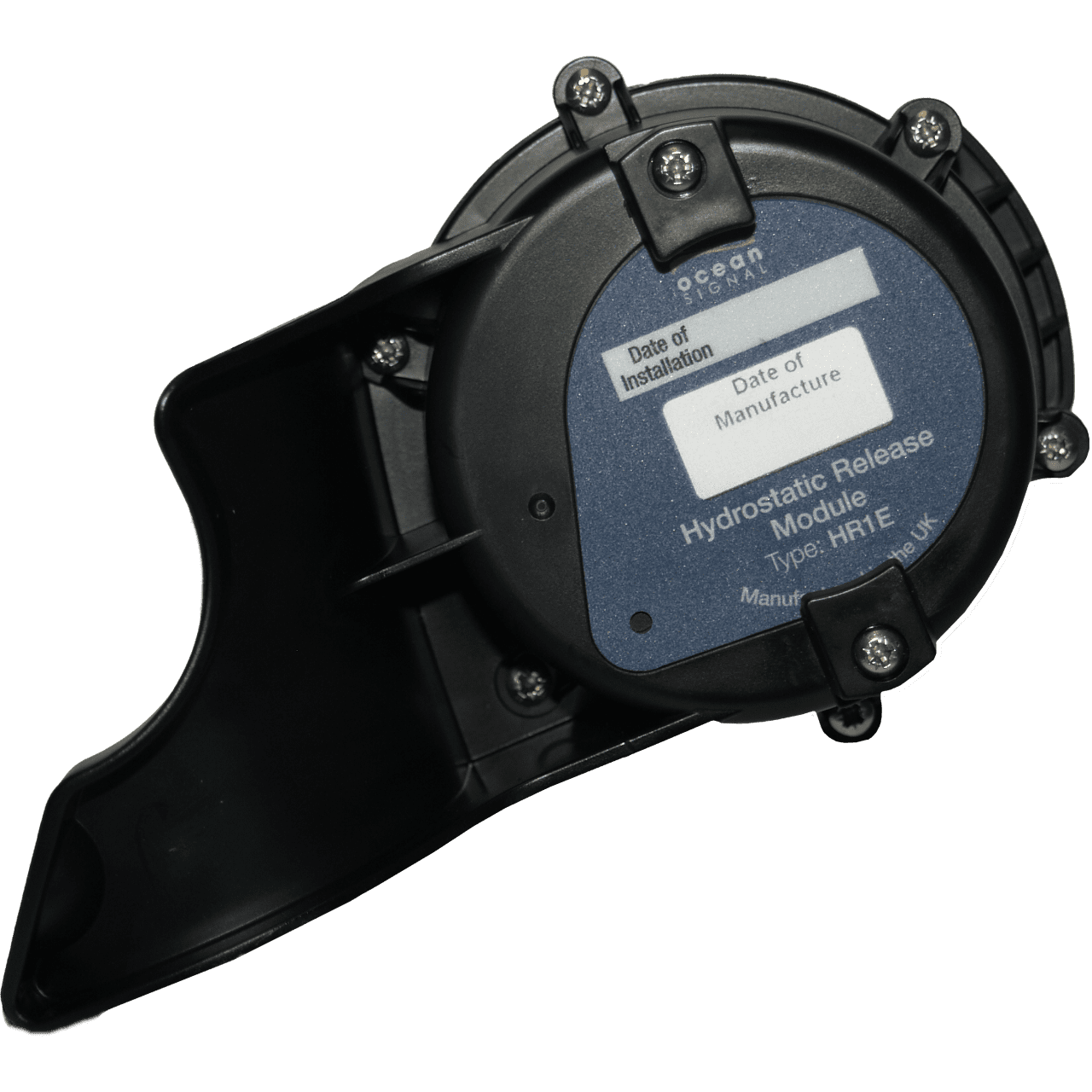
Hydrostatic water pressure release unit (HRU) specially designed for replacement in EPIRBs from the manufacturer OCEAN SIGNAL.The SafeSea HR1E (701S-00608) Hydrostatic Release Unit (HRU) fits into the following category 1 Float Free EPIRBs from OCEAN SIGNAL:SafeSea E100SafeSea E100GrescueME EPIRB1 Pro (formerly SafeSea EPIRB1 Pro )rescueME EPIRB2 ProSafeSea EPIRB3 ProSafeSea E101V VDR

MED / SOLAS approval.The easyRESCUE family from the German manufacturer WEATHERDOCK may bear the designation AIS-SART (Search and Rescue Transmitter). The world's only AIS distress transmitters with MED / SOLAS approval have a higher transmission power than a MOB (man overboard beacon), namely >2 W for AIS, >0.5 W for DSC distress calls and 50 mW for the 121.5 MHz direction finding signal. This means that their signals can be received up to ten nautical miles away.The housing of the devices is extremely robust and reliable. They can withstand multiple impacts on the water surface from a height of 20 meters, can cope with enormous temperature fluctuations and still function at temperatures below -20 °C.The small AIS-SART updates the position of the person in distress every 60 seconds and sends the AIS messages 1 (position report - dynamic data) and 14 (safety-related message). The activated AIS-SART is displayed with a red cross in a circle (the symbol according to IEC62288) on the chart plotters of vessels within a radius of up to ten nautical miles (over 20 nm with a high AIS receiving antenna).On the PRO models, the DSC distress call is initially sent in a "closed loop" to up to 8 vessels whose MMSI numbers have been programmed in advance using the free Weatherdock app via Bluetooth. If there is no confirmation within ten minutes, the system automatically switches to the "open loop" and an "all ships call" is sent to the GMDSS rescue chain as an official distress call.There are five different easyRESCUE AIS-SART models, which differ in how they are triggered (manually, by water contact, by ripcord and magnetic switch) and which frequencies (AIS, DSC, 121.5 MHz homing) they use for alerting (see table). The easyRESCUE A040-BW-COM is used by the German, Dutch and other navies as well as by the Special Forces Command (KSK) of the German Armed Forces.The easyRESCUE A040-PRO (BT) model is used by German and Dutch rescue organizations as well as by offshore wind farm personnel.The easyRESCUE PRO3 was developed for demanding sailors as an alternative to the PLB (Personal Locator Beacon, Cospas/Sarsat). In addition to alerting via AIS and DSC, a 121.5 MHz signal is transmitted. Older SAR helicopters are still in use over the North Sea and Baltic Sea, which do not have an on-board AIS and therefore prefer this "homing" frequency for locating a person in the water. The easyRESCUE PRO3 is the first choice, especially for sailors who are on the move on different yachts , because the problem of a vessel's MMSI being stored in the PLB is eliminated.Explosion-proof "ATEX" versions of the easyRESCUE AIS-SARTs are available especially for use on oil platforms, jetties and LNG ships. A version especially for divers is also available. Please ask us about this if required.Technical featuresAIS Seach-and-Rescue Transmitter (more powerful MOB with MED / SOLAS approval)96 h transmission time after activation at -20°C (longer at higher temperatures)Triggering function (depending on model): manual, by water contact, by ripcord and magnetic contactIndividual identification number of the deviceTransmission range up to 10 nm (depending on wave height and receiving antenna height)Transmission power >2 W for AIS, >0.5 W for DSC distress call and 50 mW for the 121.5 MHz direction finding signalIntegrated, fast GPS receiverBattery life >10 years (without commissioning, only self-tests). For MED / SOLAS approval, the battery must be replaced after 5 yearsWaterproof up to 10 m (IP68)Length 125 mm, width 68 mm, height 30 mmWeight approx. 210 g (A040 standard) to 350 g (PRO3)The easyRESCUE AIS-SART is integrated into the automatic lifejacket using a special pocket. This ensures that the device's antenna is in an upright position when the person who has fallen overboard is floating in the water with the lifejacket. The lifejacket manufacturers Secumar (models Scout, Survival, Alpha), Mullion, Besto and Viking have automatic lifejackets that are prepared to accommodate an easyRESCUE AIS-SART.For use in automatic vests from other manufacturers such as Kadematic, Lade, ISP, etc., the stick-on pocket (item no. 3921-114) isrequired as an accessory. Only in this pocket is the antenna of the easyRESCUE optimally aligned for transmitting the emergency signal. You can find the bag under "Accessories & spare parts".For use as an AIS-SART in the life raft , we recommend attaching the neoprene bag (item no. 3921-066) to a telescopic pole to increase the antenna height. An inexpensive telescopic boat hook (item no. 3221-161) is suitable for this purpose, see "Accessories & spare parts".

MED / SOLAS approved.Tron AIS-SART and Tron SART20 can both be used as "search and rescue locator beacons" in accordance with the IMO SOLAS amendment in resolution MSC.256(84), giving the shipowner the freedom to choose either product as required by SOLAS chapter III, regulation 2.2.JOTRON TRON SART20: This SART (Search And Rescue Transponder) radar transponder is a 9GHz transmitter/receiver for locating vessels in distress. When activated, if a pulse is received from any 9GHz X-band radar, the SART immediately sends back a signal which is clearly marked on the radar screen as a distress signal.Fibreglass reinforced polycarbonate housingFloatable, waterproof up to 1.0 mIntegrated safety lineComprehensive self-test functionsSimple activation by pull switchPower indicator with LED and acoustic signal (indicates nearby vessels after activation)Standby 96 hours, transmission time approx. 8 hoursLithium battery (hazardous material) with five-year replacement cycle (shelf life from production: 6.5 years)Five-year warrantyDimensions:H x D: 250 x 90 mm, weight 482 g.With simple wall bracket.Under "Accessories" further down on this page you will find:Battery maintenance kit (Article-No. 3950-100)Telescopic mast for use in the life raft (Article-No. 3950-120)Bracket for use in the lifeboat (Article-No. 3950-121)

Accessories for the TRON SART20 or TRON AIS-SART from JOTRON.The battery maintenance kit ensures that the TRON SART20 / AIS-SART remains ready for use for a further five years.The telescopic mast is recommended for use in a life raft. The telescopic plastic tube, which can be extended to a length of 120 cm, raises the TRON SART20 / AIS-SART to a higher position, significantly increasing the range of the transmitter.The lifeboat bracket allows the TRON SART20 / AIS-SART to be attached to a tube in the lifeboat. A dimensional drawing can be found further down on this page under "Downloads & Information".

MED / SOLAS approval.Tron AIS-SART and Tron SART20 can both be used as "search and rescue locator beacons" in accordance with the IMO SOLAS amendment in resolution MSC.256(84), giving the shipowner the freedom to choose either product as required by SOLAS chapter III, regulation 2.2.JOTRON TRON AIS-SART: This SART (Search And Rescue Transmitter) , once activated in case of distress, continuously transmits two messages over the international AIS channels (AIS A and AIS B) in the maritime VHF band containing the distress situation and the position determined by the integrated GPS. The unit is programmed by the manufacturer with a unique ID code and is thus immediately ready for operation.These messages are received by AIS-equipped ships, aircraft and shore stations in the vicinity (up to 10 nm away) and clearly marked on their plotters as the accident position. This makes it much easier to find the victim.Glass-fibre reinforced polycarbonate housingFloatable, waterproof up to 1.0 mIntegrated safety lineComprehensive self-test functionsEasy activation by pull switchStandby 96 hours, transmission time approx. 8 hoursLithium battery (hazardous material) with five-year replacement cycle (shelf life from production: 6.5 years)Five-year warrantyDimensions:H x D: 250 x 90 mm, weight 480 g.With simple wall bracket.Under "Accessories" further down on this page you will find:Battery maintenance kit (Article-No. 3950-100)Telescopic mast for use in the life raft (Article-No. 3950-120)Bracket for use in the lifeboat (Article-No. 3950-121)

The Search and Rescue Transponder (SART) ACR PATHFINDER PRO ensures that lifeboats or yachts can be found more quickly in the event of an emergency at sea. It is switched on manually, which is completely uncomplicated.When switched on, the SART is in standby mode. The X-band radar of a nearby ship activates the transponder automatically. The PATHFINDER PRO transmits a series of pulses which are displayed on the ship's radar as a line of dots showing the course to the lifeboat or the damaged yacht.Technical features:Yellow polycarbonate housingWaterproof to 10 m, floatableExcellent battery life at temperatures from -20° C to 55° C. At least 96 hours standby time plus at least 12 hours operating timeThe battery is not classified as dangerous goods and can be transported safelyBattery replacement interval: 5 years. The battery can be replaced by the userThanks to its compact size, the SART is easy to store, e.g. in the container of the life raft or in the grab bag for emergenciesLength 227 mm, diameter (max.) 65 mm (82 mm), weight 440 gA wall bracket is included in the scope of deliverySearch and Rescue Transponders (SART) are mandatory in international shipping:One on a vessel between 300 and 500 GRTTwo on a vessel > 500 GRTAt least one for every four lifeboats on RoRo passenger shipsOne on a vessel in national navigation requiring equipment, including fishing vessels, passenger vessels, merchant vessels, etc.Commercially operated yachts and most super and mega yachts are also required to carry a SART.The crews of privately operated yachts or traditional vessels also benefit from the added safety of voluntarily carrying a SART.MED/SOLAS approval (certificate under "Downloads").

The Search and Rescue Transponder (SART) OCEAN SIGNAL SafeSea S100 SART ensures that lifeboats or yachts can be found more quickly in the event of an emergency at sea. It is switched on manually, which is completely uncomplicated.When switched on, the SART is in standby mode. The X-band radar of a nearby ship activates the transponder automatically. The SafeSea S100 transmits a series of pulses which are displayed on the ship's radar as a line of dots showing the course to the lifeboat or damaged yacht.Technical features:Orange-yellow polycarbonate housingWaterproof to 10 m, floatableExcellent battery life at temperatures from -20° C to 55° C. At least 96 hours standby time plus at least 12 hours operating timeThe battery is not classified as dangerous goods and can be transported safelyBattery replacement interval: 5 years. The battery can be replaced by the userThanks to its compact size, the SART is easy to store, e.g. in the container of the life raft or in the grab bag for emergenciesLength 227 mm, diameter (max.) 65 mm (82 mm), weight 440 gA wall bracket is included in the scope of deliverySearch and Rescue Transponders (SART) are mandatory in international shipping:One on a vessel between 300 and 500 GRTTwo on a vessel > 500 GRTAt least one for every four lifeboats on RoRo passenger shipsOne on a vessel in national navigation requiring equipment, including fishing vessels, passenger vessels, merchant vessels, etc.Commercially operated yachts and most super and mega yachts are also required to carry a SART.The crews of privately operated yachts or traditional vessels also benefit from the added safety of voluntarily carrying a SART.MED/SOLAS approval (certificate under "Downloads").

Accessories for WEATHERDOCK easyRESCUE AIS-SART / MOB distress beacon.The neoprene pocket (B066) holds an easyRescue AIS-SART / MOB. It can be fastened around the arm with a Velcro fastener, for example, to keep the emergency transmitter within easy reach.The stick-on pocket (B114) is required to add an easyRescue AIS-SART / MOB to an automatic lifejacket (which is not prepared for this). The pocket ensures that the AIS-SART is optimally aligned to transmit properly after the lifejacket has been inflated.

The Ocean Signal rescueMe PLB1 is a very small personal locator beacon that transmits the distress alarm including the exact GPS position via Cospas-Sarsat (406 MHz).Before delivery, the MMSI of your vessel must be programmed into the EPIRB.To do this, please select the initial programming (Article-No. 3957-000) under "Accessories" further down on this page. In the last step of the order process, you can enter the required ship data under "Remarks": Ship name, MMSI, IMO no., call sign, flag.Would you like to use the PLB on different yachts or in a sea kayak? Then you can alternatively register the emergency transmitter in the UK using the device's own ID number. The number and details of the corresponding homepage are enclosed with the device. If you want the PLB without programming the MMSI, please indicate this under ‘Remarks’ in your order. The PLB1 can be easily attached to a lifejacket or belt using the bracket supplied, so that it is always ready for use. The emergency transmitter can be operated with just one hand. A cover protects the activation button and prevents accidental activation. The antenna is simply pulled out during use.To prevent the PLB (which itself is not buoyant) from sinking in the water, you will find a buoyant bag under ‘Accessories’.The homing signal emitted on 121.5 kHz can be used by rescuers to locate the person in the water. The extremely bright LED flash light makes it easier to locate at night.Technical data:Frequencies: 406.040 MHz (satellite), 121.5 MHz (homing signal)Standards and approvals: COSPAS SARSAT T.001/T.007, ETSI EN302 152, RTCM SC11010,NSS-PLB11, IC RSS28766-channel GPS receiverBattery runtime: > 24 hours at -20° C (longer at higher temperatures)Working temperature: -20° C - +55° CDimensions: 77 mm x 51 mm x 32.5 mm (H x W x D)Weight: 116 g

The Ocean Signal rescueMe PLB3 is a very compact personal locator beacon. It transmits the emergency alarm including the exact GPS position via Cospas-Sarsat (406 MHz) and additionally via AIS. This way, as many potential rescuers as possible are informed that a person is in the water. This significantly increases the probability of a quick rescue.Before delivery, the MMSI of your vessel must be programmed into the EPIRB.To do this, please select the initial programming (Article-No. 3957-000) under "Accessories" further down on this page. In the last step of the order process, you can enter the required ship data under "Remarks": Ship name, MMSI, IMO no., call sign, flag. Would you like to use the PLB on different yachts or in a sea kayak? Then you can alternatively register the emergency transmitter in the UK using the device's own ID number. The number and details of the corresponding homepage are enclosed with the device. If you want the PLB without programming the MMSI, please indicate this under ‘Remarks’ in your order.The release is automatic when the PLB3 has been attached to the automatic lifejacket with the supplied mounting clip. Alternatively, manual triggering is possible.To prevent the PLB (which itself is not buoyant) from sinking in the water, you will find a buoyant bag under ‘Accessories’.The RLS LED indicates when the EPIRB distress call has been received from a rescue coordination centre (Return Link Service).With an NFC (Near Field Communication) capable smartphone, the activity history, battery status and programming information can be checked via an app.The homing function (121.5 MHz) and the emission of 20 to 30 bright LED flashes (plus infrared) per minute additionally help to be found (at night).Dimensions H x W x D: : 200 mm x 36 mm x 30 mmWeight: 190 gWaterproof up to 15 metresRetractable antennaIntegrated 72 channel GPS receiver (Galileo + Glonass compatible)Transmission time at least 24 hours (at -20 °C. Longer at higher temperatures)Lithium battery with five-year replacement cycleSeven year warranty

Modular PLB pocket with harness holder that can be added to all automatic lifejackets in the SURVIVAL series:SURVIVAL 220SURVIVAL 275SURVIVAL 275 Duo ProtectThis allows the following marine distress transmitters to be safely integrated into the lifejacket:Ocean Signal RescueME PLB1ACR ResQLinkKannad SafeLink R10McMurdo Smartfind S20

The ACR ResQLink 400 View is an extra small PLB (Personal Locator Beacon) that fits in one hand and in any pocket. It has a 66-channel GPS receiver.Before delivery, the MMSI of your vessel must be programmed into the EPIRB.To do this, please select the initial programming (Article-No. 3957-000) under "Accessories" further down on this page. In the last step of the order process, you can enter the required ship data under "Remarks": Ship name, MMSI, IMO no., call sign, flag.Would you like to use the PLB on different yachts or in a sea kayak? Then you can alternatively register the emergency transmitter in the UK using the device's own ID number. The number and details of the corresponding homepage are enclosed with the device. If you want the PLB without programming the MMSI, please indicate this under ‘Remarks’ in your order. After activation in case of distress, the PLB alerts the worldwide available satellites of the COSPAS/SARSAT system on the frequency 406 MHz. Together with the distress message, the MMSI of the vessel and the exact position of the PLB are transmitted.This distress message is received by a ground station and passed on to the sea rescue centre of the disaster area, which initiates and coordinates the rescue operation. Alarmed rescue aircraft and ships are then guided to the scene of the accident via a VHF homing signal on 121.5 MHz. In addition, the buoyant PLB emits an LED (and infrared) strobe signal to aid location.Integrated 66-channel GPS/GALILEO receiver.Compatible with next generation satellites (MEOSAR).Powerful LED and infrared flash.Transmission time of at least 24 hours.Waterproof (to 5 m), buoyant, bright yellow polycarbonate housing.Transmitting power 5 watts.Coloured LEDs indicate successful signal transmission when activated.Lithium battery with 5-year replacement cycle (non-hazardous).Self-test functions.5-year warranty.Delivery includes various attachment clips to allow integration into lifejacket, backpack, jacket, etc.
Initial programming of a new device purchased from us!An EPIRB - and therefore also a PLB (Personal Locator Beacon) - i.e. a COSPAS-SARSAT satellite radio beacon is generally subject to registration in Germany.Both EPIRBs and PLBs are registered on a ship-by-ship basis. This means that the MMSI of your own ship is programmed into the device, which - unlike with a radio - you cannot do yourself. Alternatively, the PLB can also be registered in the UK on a device/person basis.Therefore, please enter the required ship data in the last step of the order under "Remarks":Ship nameMMSIIMO no. (if available)Call signFlagYou can also send us a copy (e-mail attachment) of the first page of your Ship Station Licence (certificate of assignment).You will receive the corresponding coding certificate (including 15-digit HEX ID code, "protected message") with the device, which you submit to the Federal Network Agency, Hamburg field office.The form for the "Application for the allocation of numbers of the mobile maritime and inland waterway radio call sign, MMSI and ATIS for recreational navigation (SHIP STATION LICENCE)" is used for new applications and applications for amendments.You can find it here: www.bundesnetzagentur.deThe details of your EPIRB / PLB will then be stored with the ITU* and the MRCC** Bremen so that appropriate action can be taken in the event of an emergency at sea. For example, a telephone call can be made to a designated person on shore to check whether it may be a genuine emergency.* The International Telecommunication Union (ITU)** Maritime Rescue Coordination Center (MRCC)

The MT610G is a very compact, lightweight PLB (Personal Locator Beacon) from the Australian manufacturer GME.It transmits the emergency alarm including the exact GPS position via Cospas-Sarsat (406 MHz). The 121.5 MHz frequency is also used for homing.Before delivery, the MMSI of your ship must be programmed into the PLB. To do this, please select the initial programming (item no. 3957-000) under "Accessories & spare parts". In the last step of the order process, you can enter the required ship data under "Remarks": Ship name, MMSI, IMO no., call sign, flag. Would you like to use the PLB on different yachts or in a sea kayak? Then the initial programming (item no. 3957-000) is also mandatory for this PLB. Please indicate under "Remarks" in your order whether you require a British or an Australian device ID. You can then use this device ID to register the PLB in the UK or Australia yourself via this website (for the UK or Australia).Activation is done by switching on the device manually. The emergency signal is sent after 30 seconds at the earliest. Due to the digital frequency processing, no warm-up time is required. The device automatically carries out an extensive internal test and provides information on the result via LED displays.Technical featuresCompact, lightweight designHighly visible yellow housing colorFloatableDust and waterproof according to IP68 protection classEasy to operate even with clammy fingersCospas-Sarsat certified (class 2)121.5 MHz transmitter for homingIntegrated 72-channel GPS receiverLED flash with 20 flashes/minute (>0.75 cd)Operating time at least 24 hours at -20° C (longer at higher temperatures)Battery life 7 years - no later than the printed expiration date. Replacement must be carried out by a service company6-year guaranteeDimensions: HxWxD 88 x 66 x 36 mmWeight: 180 gscope of deliveryMT610G PLBSafety lanyardInstructions for useQuick start guide

The Ocean Signal rescueMe PLB1 can be safely stowed in this buoyant bag. The PLB fits perfectly in the bag. The press stud fastener prevents the emergency transmitter from falling out.The bag has a webbing loop on the back that can be used to attach it (to the oilskin or lifejacket).The bag ensures that the PLB1 (which itself is not buoyant) does not sink in the water.

The Ocean Signal PLB3 can be safely stowed in this buoyant bag. The PLB sits tightly in the bag.The bag has a webbing loop on the back that can be used to attach it (to your oilskin or lifejacket).The bag ensures that the PLB3 (which itself is not buoyant) does not sink in the water.

The Ocean Signal rescueME MOB2 is currently the smallest AIS MOB transmitter on the market that complies with the standard for AIS Man Over Board devices (AIS MOB standard IEC63269:2022) and has been certified accordingly . The standard (ECDIS 63269 IEC 2022) from January 1, 2021 states that all AIS MOB devices with DSC (Digital Selective Calling) must also have a DSC receiver. In addition, all automatic mechanisms must be able to be switched off. The sale of AIS MOB devices that do not comply with this standard is prohibited.The MOB2 can be easily integrated into any automatic lifejacket and is automatically activated when the lifejacket is deployed. The first alarm is sent after 15 seconds. The integrated dual LED flash light (white and infrared) ensures that the person who has fallen overboard is clearly visible even at night.Immediately after activating the MOB2, a DSC alarm sounds on your own ship - if you have previously stored the MMSI of the radio in the emergency transmitter. This programming is possible with an NFC (Near Field Communication) compatible smartphone and the free app. The app also offers a GPS test, a self-test and the option to check the maintenance intervals. The AIS signal provides the exact GPS position on AIS-compatible chart plotters that are within VHF range of the transmitter. The "person overboard" is displayed accordingly.Technical data:Frequencies: 161.975/162.025 (AIS), 156.525 (DSC)Battery life: > 24 hours at -20° COperating temperature: -20° C - +55° CWeight: 92 gDimensions: 134 mm x 38 mm x 27 mm (H x W x D)Standards and approvals: RTCM SC11901, EN303 098-1 AIS (Automatic Identification System)Integrated DSC transceiver (Digital Selective Call)*Class M (European regulation ECC/DEC/(22)02)The LED indicates whether the DSC alarm has been receivedEasy attachment to the automatic lifejacketAutomatic activation when the lifejacket is inflated5 year battery life> 12 hours operating timeNFC (Near Field Communication)5 year warranty66-channel GPS receiver (GPS and Galileo)Waterproof up to 20 m* The use and function of DSC is subject to the legislation of the respective country.

The easy2-MOB from the German manufacturer Weatherdock is a small man overboard beacon (MOB) with DSC and AIS alerting.The easy2-MOB was developed for recreational boating, but is also used by the Spanish customs and border police Servicio de Vigilancia Aduanera, for example. The technology is the same as in the easyRESCUE AIS-SART, except for the slightly lower transmission power, which means that MED/SOLAS approval is not required.The easy2-MOB is simply packed "upside down" between the folded float of the automatic lifejacket and knotted to a loop or D-ring of the vest using the safety line. The outer shell only needs to be opened slightly for this. No special attachment is required, which means that the MOB can be used in all standard lifejackets. To activate the automatic release, the yellow slider is pushed to the "armed" position.Using a Bluetooth connection, up to eight MMSI numbers (of your own ship and of ships sailing in the same area) can be stored in the device using a smartphone and the free Weatherdock app (iOS11, Android6 or higher). The app also offers a test and alarm history with date, time and position.In a person-overboard situation, the lifejacket inflates on contact with the water. The easy2-MOB floats next to the swimmer and is activated automatically (manual activation is also possible). After a few seconds, the first transmission is made to the ships whose MMSI is programmed in. The unit ID of the AIS-MOB is transmitted first, as the device has not yet determined a position. In this "close loop" step, the crews of the programmed ships are made aware of the dangerous situation. As soon as the position has been determined, they are informed again.Parallel to the DSC transmission, an AIS distress message is sent as soon as the position has been determined. This can be received by any ship with an AIS receiver within a radius of up to 7 nautical miles. The transmitted position data is updated every minute and resent together with information on course and speed over ground.If the "closed loop distress call" is not acknowledged by one of the programmed ships within ten minutes of the alarm being raised, the easy2-MOB automatically switches to the "open loop distress call" and sends a distress signal to all ships. This allows the distress call to reach a coastal station and trigger a rescue operation there. The easy2-MOB can receive confirmation of the distress call, which leads to further DSC transmissions being switched off.Six powerful red LEDs ensure that the MOB can also be used as an electronic torch. This makes it much easier to find the person in the water, especially at night. Technical data:CE approvalStorage temperature: -40°C to +70°COperating temperature: -20°C to +55°CBattery life: 12 hours at -20°C (longer at higher temperatures)Batteries: 2 lithium units (CR2)Frequencies / transmission power: AIS: 161.75 and 162.025 MHz (1 W). DSC: 156.525 MHz (0.5 W)Dimensions: 195 x 50 x 32 mmWeight: 120 gThe easy2-MOB was the first MOB on the market to be fully compliant and certified with the new standard for AIS Man Over Board devices (AIS-MOB standard IEC63269:2022). The standard (ECDIS 63269 IEC 2022) from January 1, 2021 states that all AIS MOB devices with DSC (Digital Selective Calling) must also have a DSC receiver. In addition, all automatic mechanisms must be able to be switched off.Accessories:The optional bracket allows the MOB to be attached to the companionway, for example, within easy reach.With the refit kit , the MOB can be made ready for use again after activation. The release tablet in the MOB should also be replaced at least once a year.
MED / SOLAS approval.The easyRESCUE family from the German manufacturer WEATHERDOCK may bear the designation AIS-SART (Search and Rescue Transmitter). The world's only AIS distress transmitters with MED / SOLAS approval have a higher transmission power than a MOB (man overboard beacon), namely >2 W for AIS, >0.5 W for DSC distress calls and 50 mW for the 121.5 MHz direction finding signal. This means that their signals can be received up to ten nautical miles away.The housing of the devices is extremely robust and reliable. They can withstand multiple impacts on the water surface from a height of 20 meters, can cope with enormous temperature fluctuations and still function at temperatures below -20 °C.The small AIS-SART updates the position of the person in distress every 60 seconds and sends the AIS messages 1 (position report - dynamic data) and 14 (safety-related message). The activated AIS-SART is displayed with a red cross in a circle (the symbol according to IEC62288) on the chart plotters of vessels within a radius of up to ten nautical miles (over 20 nm with a high AIS receiving antenna).On the PRO models, the DSC distress call is initially sent in a "closed loop" to up to 8 vessels whose MMSI numbers have been programmed in advance using the free Weatherdock app via Bluetooth. If there is no confirmation within ten minutes, the system automatically switches to the "open loop" and an "all ships call" is sent to the GMDSS rescue chain as an official distress call.There are five different easyRESCUE AIS-SART models, which differ in how they are triggered (manually, by water contact, by ripcord and magnetic switch) and which frequencies (AIS, DSC, 121.5 MHz homing) they use for alerting (see table). The easyRESCUE A040-BW-COM is used by the German, Dutch and other navies as well as by the Special Forces Command (KSK) of the German Armed Forces.The easyRESCUE A040-PRO (BT) model is used by German and Dutch rescue organizations as well as by offshore wind farm personnel.The easyRESCUE PRO3 was developed for demanding sailors as an alternative to the PLB (Personal Locator Beacon, Cospas/Sarsat). In addition to alerting via AIS and DSC, a 121.5 MHz signal is transmitted. Older SAR helicopters are still in use over the North Sea and Baltic Sea, which do not have an on-board AIS and therefore prefer this "homing" frequency for locating a person in the water. The easyRESCUE PRO3 is the first choice, especially for sailors who are on the move on different yachts , because the problem of a vessel's MMSI being stored in the PLB is eliminated.Explosion-proof "ATEX" versions of the easyRESCUE AIS-SARTs are available especially for use on oil platforms, jetties and LNG ships. A version especially for divers is also available. Please ask us about this if required.Technical featuresAIS Seach-and-Rescue Transmitter (more powerful MOB with MED / SOLAS approval)96 h transmission time after activation at -20°C (longer at higher temperatures)Triggering function (depending on model): manual, by water contact, by ripcord and magnetic contactIndividual identification number of the deviceTransmission range up to 10 nm (depending on wave height and receiving antenna height)Transmission power >2 W for AIS, >0.5 W for DSC distress call and 50 mW for the 121.5 MHz direction finding signalIntegrated, fast GPS receiverBattery life >10 years (without commissioning, only self-tests). For MED / SOLAS approval, the battery must be replaced after 5 yearsWaterproof up to 10 m (IP68)Length 125 mm, width 68 mm, height 30 mmWeight approx. 210 g (A040 standard) to 350 g (PRO3)The easyRESCUE AIS-SART is integrated into the automatic lifejacket using a special pocket. This ensures that the device's antenna is in an upright position when the person who has fallen overboard is floating in the water with the lifejacket. The lifejacket manufacturers Secumar (models Scout, Survival, Alpha), Mullion, Besto and Viking have automatic lifejackets that are prepared to accommodate an easyRESCUE AIS-SART.For use in automatic vests from other manufacturers such as Kadematic, Lade, ISP, etc., the stick-on pocket (item no. 3921-114) isrequired as an accessory. Only in this pocket is the antenna of the easyRESCUE optimally aligned for transmitting the emergency signal. You can find the bag under "Accessories & spare parts".For use as an AIS-SART in the life raft , we recommend attaching the neoprene bag (item no. 3921-066) to a telescopic pole to increase the antenna height. An inexpensive telescopic boat hook (item no. 3221-161) is suitable for this purpose, see "Accessories & spare parts".

Accessories for WEATHERDOCK easyONE/easy2-MOB emergency transmitters.The refit kit (B113) consists of a 3 mm Allen key and two release tablets for the automatic release mechanism in the emergency transmitter. This allows your easyONE or easy2-MOB to be made ready for use again after contact with water.The tablet for automatic release must be replaced after contact with water. In order to ensure functionality at all times, it should also be replaced at least once a year as it ages.The holder (B126) ensures that the easy2-MOB or easyONE-MOB is always ready to hand on board.The red holder made of impact-resistant plastic with a gripping part made of rubber-like, flexible plastic can be screwed to the companionway or the chart table, for example, so that the emergency transmitter can be reached quickly in an emergency and is not forgotten. The holder is weatherproof and can be screwed or glued on depending on the surface. Dimensions: 8 x 8 x 3.5 cm.
Accessories for WEATHERDOCK easyRESCUE AIS-SART / MOB distress beacon.The neoprene pocket (B066) holds an easyRescue AIS-SART / MOB. It can be fastened around the arm with a Velcro fastener, for example, to keep the emergency transmitter within easy reach.The stick-on pocket (B114) is required to add an easyRescue AIS-SART / MOB to an automatic lifejacket (which is not prepared for this). The pocket ensures that the AIS-SART is optimally aligned to transmit properly after the lifejacket has been inflated.

Personal emergency transmitter that can be worn in its neoprene pocket in the lifejacket or on the oilskin. The sMRT ALERT MOB can be activated both manually and fully automatically (by contact with water). Once activated, the DSC distress signal is sent automatically to alert nearby vessels to the person who has gone overboard. The activation of the MOB and the transmission of the DSC signal are indicated by an acoustic signal and a strong flashing of the strobe LED. The position of the MOB is transmitted in real time via AIS. GPS and Galileo signals are combined for this purpose.As soon as the DSC distress call is received by a ship, a confirmation is sent to the MOB. The DSC alarm is then deactivated for all other ships. The position of the MOB is still transmitted via AIS.In the event of a false alarm, there is a delete option to cancel false activations.Technical featuresFrequencies: 161.975/162.025 (AIS) 156.525 (DSC channel 70)Battery runtime: > 12 hours at -20 °COperating temperature: -20 to 55 °CDimensions: (L x W x H) 137 mm x 62 mm x 26 mmWeight: 212 gStandards and approvals: RTCM SC11901.1, EN303 132 V2.1.1The sMRT Alert complies with the standard for AIS Man Over Board devices (AIS MOB standard IEC63269:2022) and is certified accordingly. The standard (ECDIS 63269 IEC 2022) from January 1, 2021 states that all AIS MOB devices with DSC (Digital Selective Calling) must also have a DSC receiver. In addition, all automatic mechanisms must be able to be switched off.The sMRT beacon management app can be used with an NFC (Near Field Communication) enabled smartphone.App functionsRegistration of the productSignal and fault checksViewing test logsChecking the current battery statusCreating travel routes that can also be sent

The Ocean Signal AIS Alarm ensures that any AIS MOB or AIS SART activation immediately triggers an 87 dB audible alarm.Thanks to its simple design, compact housing and NMEA-0183 connection, the AIS Alarm can be quickly connected to an existing NMEA-0183 network or to an AIS receiver.Up to 30 device IDs of AIS SARTs (974ff) or AIS MOBs (972ff) can be stored (USB cable, free software). This allows an alarm to be assigned precisely. The internal relay allows the AIS alarm to be connected to an external siren or to the ignition of the engine for automatic shutdown.The AIS Alarm from Ocean Signal is waterproof and can be installed outdoors. The power supply is 12 V (10.8 V - 15.6 V DC).Flush or bracket mountingWaterproof (for outdoor installation)Programmable with up to 30 individual device IDsNMEA-0183 input (38,400 baud)Power and USB cable includedProgramming software available online free of chargeRecognizes AIS SART and AIS MOB devicesDifferent tones for recognizing the stored devicesAlarms for all received or specific targetsNMEA input and output (pass-through port) for easy integration into the network