Traditional wooden sailing ships such as gaff cutters, pilot cutters, trawlers, Colin Archers, barges and classic wooden yachts have to be resealed from time to time. The traditional method of waterproofing the deck and planking seams of wooden boats is an almost extinct craft that is kept alive by ship lovers and boatbuilding enthusiasts - it is known as traditional caulking. Caulking cotton or oakum is driven into the seams of the ship's planks. By using a seaming ladle the seam is poured with heated, liquid pitch. At Toplicht, boat builders and wooden boat and the water will run into a depression somewhere. Marine sealants, adhesives and marine deck caulking sealants in a pouch or cartridge are suitable for sealing, bonding, glueing or grouting of windows, fittings, through-hulls, rubbing bands and deck planking. Most of them are weather-resistant, permanently elastic and sandable. At Toplicht, you will find a wide range of sealants, construction glues and elastic adhesives on a 2-component epoxy resin base.
Traditional sealing & caulking


Fiber containing, elastic bitumen filler. Very good adhesion properties, even on damp surfaces. Resistant to sea water, thus exceptionally well suited for grouting plank seams. After setting, the kit is permanently elastic and watertight.May not be used for deck seams.

As is commonly used in Scandinavia, caulk with a bitumen base for traditional construction, for pouring into deck seams. The chunks must be made liquid through heating and spread with a steaming ladle or filler into the deck seams.Colour: black.Average usage: 1 kg to 10 metre run.Please download our traditional pamphlet No 8 "caulking" (only in german language, we regret) at "Downloads & Information" below.

Exclusive at TOPLICHT: Traditional planking wax, which is used in Sweden and elsewhere to seal small underwater leaks and cracks in wooden planking. The brown wax stays soft and will not harm the joints and planks, even in clinker-built boats. Can be applied, even to damp planks, from inside or outside with a putty knife, wood chip or (if warmed) with a brush.Sticks like the devil! This high - grade material will not be washed out by salt or fresh water. Composition: balsam resin, beech tar, wax, linseed oil, colophony.To be used underwater only. If used on deck, it may soften in summer heat and give brown marks to clothing.

Hot bitumen sealant for spreading or moulding caulking underwater plank seams.The compound must be liquefied by heating (approx. 180° C) and applied to the caulking underwater seams with a spatula, brush or roller. Not suitable for deck seams, as the compound softens in strong sunlight. The product is only available as a whole block.Further information on the subject of caulking can be found in our data sheet no. 8 "Caulking". You will find it below under "Downloads & Information".

JEFFERY (not: JEFFREY) marine glue:English marine glue for traditional construction, for heating and pouring into deck seams.Thanks to its special composition, this marine glue is very heat resistant and barely fades in intensive sunlight. Appropriate for ships in warm areas.The chunks must be made liquid by heating (to approx. 200 degrees C) and then spread with a seaming ladle or filler into the deck seams. Specific weight: 1.36 g/ccm.Colour: black.Should normally be applied in two layers to avoid bubbles.Average usage: 1 kg to 10 metre seam run.

Heavy steel ladle, that holds its heat for a long time when in use. For pouring marine glue in sealing decks. Hand-forged from a single piece. With hooked handle (length 380 mm) and forward spout. Entire length 500 mm, ladle diameter 120 mm (approx. 0.45 l). Weight approx. 1.2 kg. Please order see "Further Information" for our information sheet No. 8 "Caulking" below.
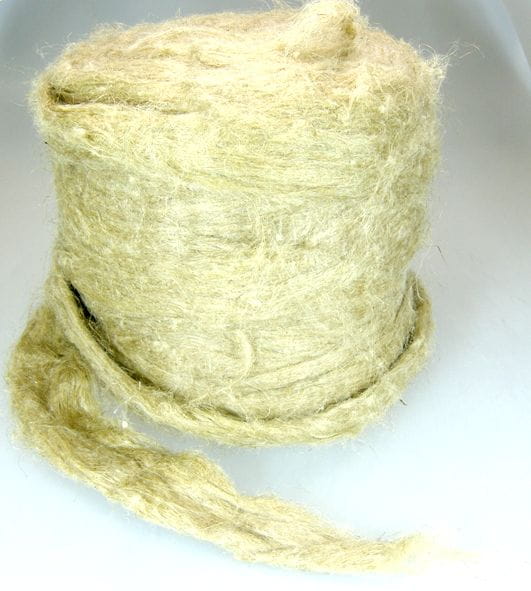
Ship's wharf for calfing the plank seams. Type Marine-Oakum No. 3, tarred. Medium-fine, long-fibered calfate tow made of flax fiber. The tow is impregnated with wood tar and wound into balls of approx. 4kg each (running length approx. 25m/kg).Delivery form: One box of 3 balls (approx. 4kg each) with approx. 12kg (minimum delivery quantity).

Oakum for caulking plank seams.Type Navy-Oakum No. 1, tarred. Light, very fine, long-stranded oakum made from pure, precision pulled manila fibres. Impregnated with Swedish wood tar.Easy to work with, because the oakum is coiled in pull resistant bound balls of approx. 4 kg, with running length of approx. 30 m/kg. Deliverey options: 150 g handy pack in a dispenser box,Coil of approx. 4 kg,Coil of approx. 1 kg, Bag of approx. 25 kg, that include 6 balls.

White, soft, slightly twisted cord made of pure, very fine Egyptian cotton. This cotton cord is ideally suited for caulking and sealing in wooden boat building, proven for decades. Two qualities are available:Type DE: The strands are fine and very uniform, the cord is twisted a little tighter.12 threads per cord, diameter approx. 6 mm, single strands 1 to 2 mm, NM1,22/12.Type GB: The strands are somewhat thicker and more uneven, the cord is softly twisted.8 threads per cord, diameter approx. 8 mm, single strands 2 to 3 mm, NM 1,1/8.

Ship felt, also known as Irish felt, is a product that was originally produced in Belfast, Ireland. It consists of long jute fibers and is impregnated with bitumen. Due to the long fibers, ship felt has excellent tensile strength and adapts to uneven or odd shapes.In traditional shipbuilding, the felt is used as an intermediate layer for wood/wood or wood/steel joints, for example between two layers of planking or under metal sheathing.Available as meterpiece, or as a 25 m roll.